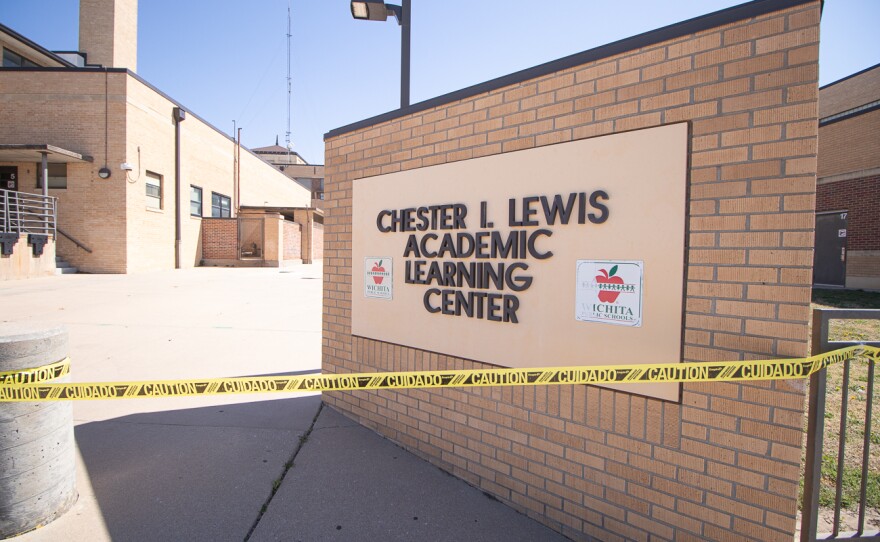
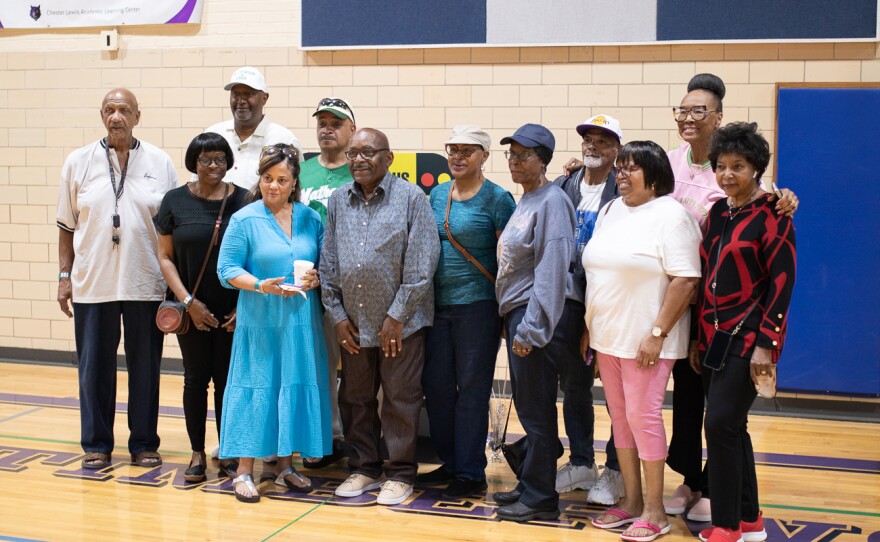
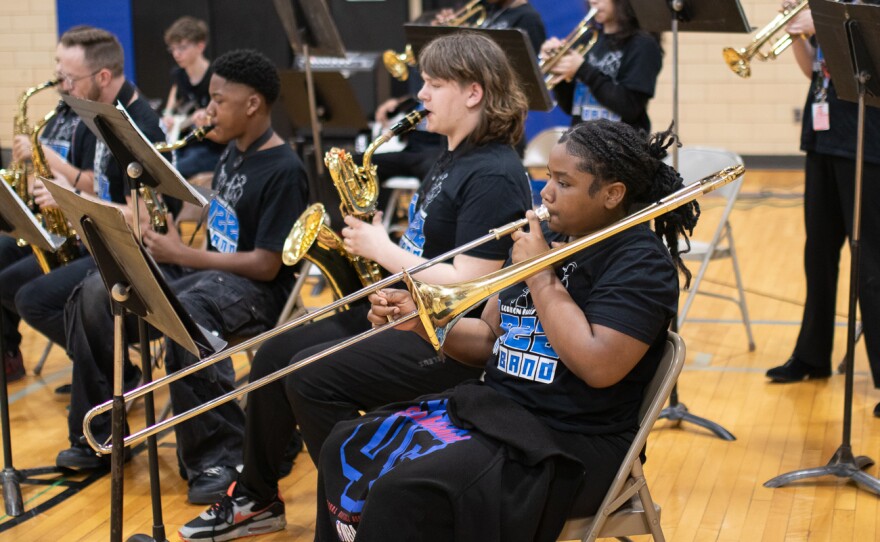
Former students, teachers and other members of the community gathered Thursday for an open house at the former Chester I. Lewis Academic Learning Center in northeast Wichita.
Wichita school district officials closed the building in December after discovering unsafe structural conditions there. The district relocated students and teachers to the former Cleaveland Elementary School building in southwest Wichita.
The building was originally Mathewson Junior High, and it served as a community pillar to the predominantly Black surrounding neighborhood.
The district closed the school in the late 1960s, heeding a recommendation from the federal Office of Civil Rights as part of efforts to racially integrate schools, according to The Community Voice.
But that decision meant many Black students had to be bused to different schools across the district, outside of the neighborhood they grew up in.
Leon Hare, a former student at Mathewson, said his teachers there prepared him for the experience of attending an integrated school.
“When we left here, we had to go (to school) where there were different races, but we understood,” he said. “We got an education here to be able to get along with everyone.”
He recalled a homeroom teacher who exposed him and his classmates to other neighborhoods.
“She opened our eyes by taking us to the movies outside of our community. She took us to the libraries outside of our community because we didn't have libraries here,” he said. “She opened our horizons to be able to go out and venture.”
Lavonta Williams, vice president of the local NAACP and former Wichita City Council member, said the school was where she met the gym teacher who would become a key role model in her life: Ms. Minnie Brown.
Ms. Brown inspired Williams to go on to work as a gym teacher at Hamilton Middle School for many years.

“I wanted to be that same type of an example. I wanted any child that I taught to know that they were enough,” she said. “Because this was a predominantly Black middle school — junior high school — and the teachers that were here made us feel that we were enough.”
Williams said it will take time for the neighborhood to adjust after losing the community staple.
“This holds memories for us,” she said. “It’s going to be sad, because we just took it for granted. We always passed by here, and it was always here.”
The district briefly reopened the former Mathewson building in the late 1980s as a community education center before it became Northeast Magnet High School. When Northeast moved in 2012, the building became Chester Lewis, housing the district’s alternative high school and other programs.
The building is named after Chester Lewis, a key figure in the historic Dockum Drug Store Sit-In and in the integration of Wichita schools.
Lewis’ name remains attached to the alternative high school program, but many in the community have asked the district to find a way to keep the name in the neighborhood.
The district had already planned to close the Chester Lewis building as part of its 2024 Facility Master Plan but expedited the closure after discovering the structural damage.
“After structural concerns were discovered during a routine inspection this fall, and given long-term plans for the site, it was more fiscally responsible to move students and staff than invest in the building,” reads a statement from a district spokesperson.
Thursday’s event was limited primarily to the gym and auditorium, with much of the building roped off for demolition.
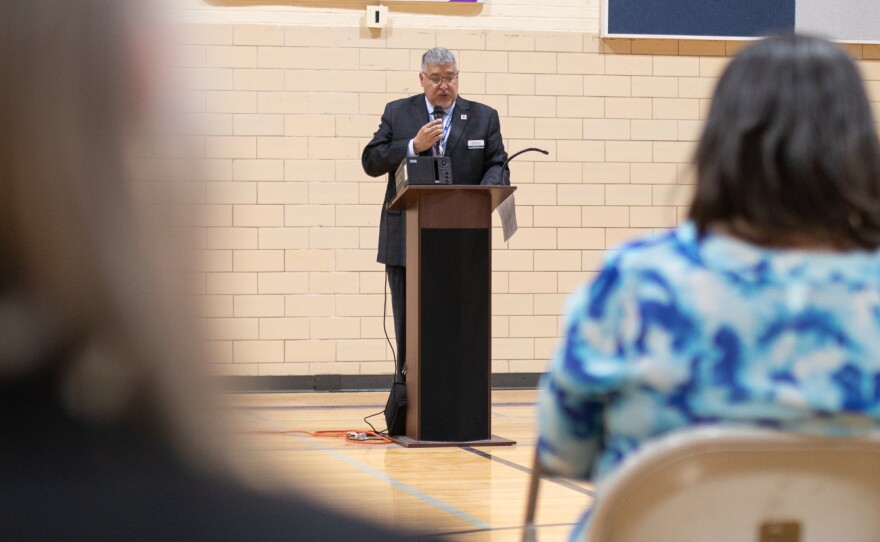
Gil Alvarez, deputy superintendent at USD 259 and a former principal at Northeast, said the district will demolish the building no later than this summer.
“This decision is not about the legacy of the school,” he said. “It’s about the condition of the structure and our responsibility to ensure safety and sustainability.”
A failed 2025 bond proposal would have replaced the building with an early childhood center. District officials are planning to pitch another bond issue to voters this November, but it’s not yet clear if that bond will include the same plan.
After recent closures, Williams said she fears Wichita will lose its neighborhood schools. She said she hopes the district will ultimately put an early childhood center in the building’s former space.
“Don’t make it more of a school desert than it is right now.”