

The bridge over the Little Arkansas River, along 13th Street in Wichita’s Riverside neighborhood, is known for its architecture, which includes Native American busts and buffalo portraits.
Minisa Bridge was built in 1932 and was recently accepted into the U.S. National Register of Historic Places — something that was made possible in part by Susie Cunningham, a Riverside resident who can see the bridge from her backyard.

"There's only six or seven houses here that back up to the river, and it was always my goal to buy one," Cunningham said. "It took me a long time, and that's what I think about is, I finally landed where I belong.”
Cunningham is president of the Little Arkansas Community Coalition, a group of people who live along the river and advocate for the ecology and preservation of the neighborhood.
With the help of the coalition, local historians, and a lot of research, the bridge is finally getting the recognition Cunningham says it deserves.
“I really wanted people to know that this bridge belongs to everyone,” she said. “It's a national treasure, not just Riverside's, you know? It's important to everyone.”
The process started two years ago, after Cunningham discovered that federal grant money was available for infrastructure. She saw it as an opportunity to get funds to maintain the bridge, something she hadn't seen done in a long time.
“I want a regularly scheduled maintenance program that's fully funded so that it never gets bad again, so we don't lose it,“ Cunningham said.
The history of Minisa Bridge is connected to the high school just steps away.
In 1931, a teacher at Wichita North High School thought the bridge should be designed similar to the school. After it was built, students voted to name it “Minisa,” a Native term meaning “red water at sunset."

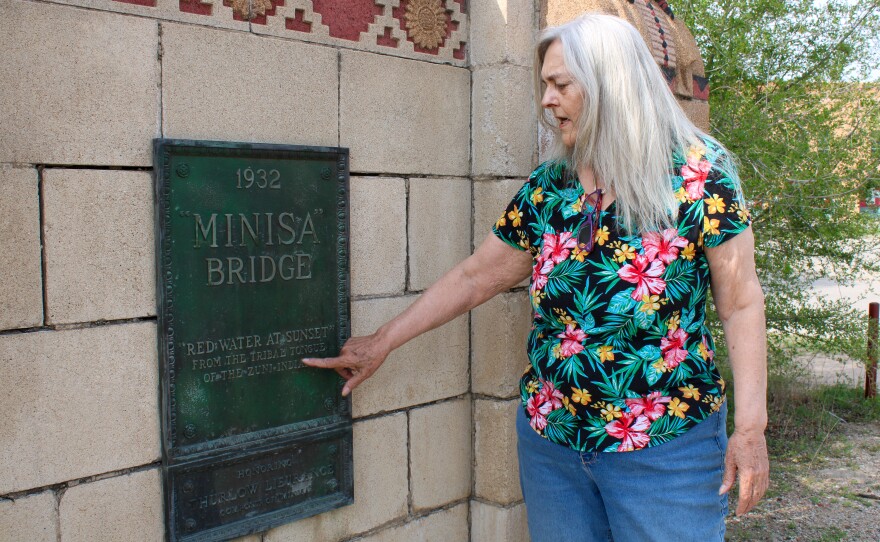


According to a book written by the teacher, thousands of people attended an opening ceremony for the bridge.
These days, the walls beneath the bridge are covered in graffiti, and some of the busts have broken noses or lips. Cunningham said she continues to be frustrated by its condition.
Chemicals used to remove the graffiti can damage the bridge's surface, which is made of Carthalite.
Carthalite is a cement and mineral mixture that originated in Wichita. It gives the bridge its bright blue, green and red colors. Minisa is thought to be one of the only bridges in the world — and possibly the only one — made of the unique material.
Local historian Jay Price said the Art Deco and Native American imagery on the bridge was common in the 1920’s.
“Carthalite is one of those new technologies that they are trying out, so that becomes a sign of Wichita's kind of prominence as a growing industrial city.” Price said.
Pieces of the precious Carthalite have since chipped or broken off.
The last renovations on the bridge were around 15 years ago.

Jordon Kaspar, who teaches band at North High, said he remembers singing on the bridge as a student when renovations were completed. He got to keep an engraved brick from the original road.
He said students might appreciate the bridge more if its history was more accessible to them.
“If there's some sort of interactive thing that you can have on the bridge, I think that would definitely help sort of tell the story for longer and have at least people understand what the meaning is for Minisa’s bridge,” Kaspar said.
Renovations and repairs on the bridge are expected to begin this summer, once school is out.
As Cunningham walks her dog, she looks over and sees her house from the bridge. Her canoes are laid out, waiting to be used as the weather gets warmer.
She said she hopes the bridge’s new spot on the historic registry helps community members and students appreciate it as much as she does.
"It's just all about who was here, and they'll never be forgotten,” she said.
