

On a summer weekend full of festivals and World Cup parties, the auditorium at the Kansas Leadership Center buzzed because of something historic. The downtown Wichita auditorium managed to gather a room full of middle schoolers for a day dedicated to government.
That wasn’t the historic part, though.
The students gathered for the opportunity to represent the Sunflower State in the first truly national Civics Bee. This fall, one student from each of the 50 states will travel to Washington, D.C., to compete in the National Civics Bee.
It’s an important milestone for the competition that started as a way to combat an education and civic engagement crisis in the United States.
In 2022, the Annenberg Public Policy Center found that less than half of U.S. adults could name all three branches of government. That same year, the National Assessment of Educational Progress found that 78% of eighth graders had a less than proficient understanding of civics.
That reports set off alarm bells for the U.S. Chamber of Commerce Foundation. The national business organization launched a civics initiative and created a pilot competition in Iowa, Kentucky, Maryland, New Mexico, Texas and Wyoming.

The goal of the civics bee is to raise the bar for the next generation and create a better engaged and informed citizenry.
In its inaugural year, 981 students from 135 schools participated in either the regional, state or national competition. Last year, 12,000 students from 39 states entered the competition.
Tanya Ramesh, now a high school student in Wichita, represented Kansas among the national competitors last year. She told students who came out for the state championships this year that her time in Washington was a front row seat to how the bee is promoting engagement in her generation.
“So often today we hear about what divides people,” Ramesh said. “Yet there I was, surrounded by proof that the desire to serve is not partisan, it’s not regional, it’s not political. It’s human, and it’s American.”
Ramesh finished fourth on the national stage following a tie-breaker question for the third place title.
“I was surrounded by students from across the United States who chose service over apathy, progress over cynicism and community above everything,” she said.

The civics bee is often compared to spelling bee competitions. While some of the competition mechanics follow a similar pattern to spelling bees, the civics competition asks students to take their studies of government and citizenship a step beyond memorization and put those lessons into practice.
To enter the competition, sixth-, seventh- and eighth-grade students write an essay pitching an idea for how to improve their community. Judges selected by their local chambers of commerce sort through the pitches and pick a slate of students to compete in a regional competition.
Like the state level competition, the regional gathering narrows down the student competitors through a series of multiple-choice questions on subjects like the Federalist Papers, foundational Supreme Court cases, the powers of the branches of government and rights of the citizenry.
The top scoring students present their community improvement ideas to a panel of judges who grade the ideas based on the students’ civic knowledge, communication, use of evidence and the strength of their proposed solution.

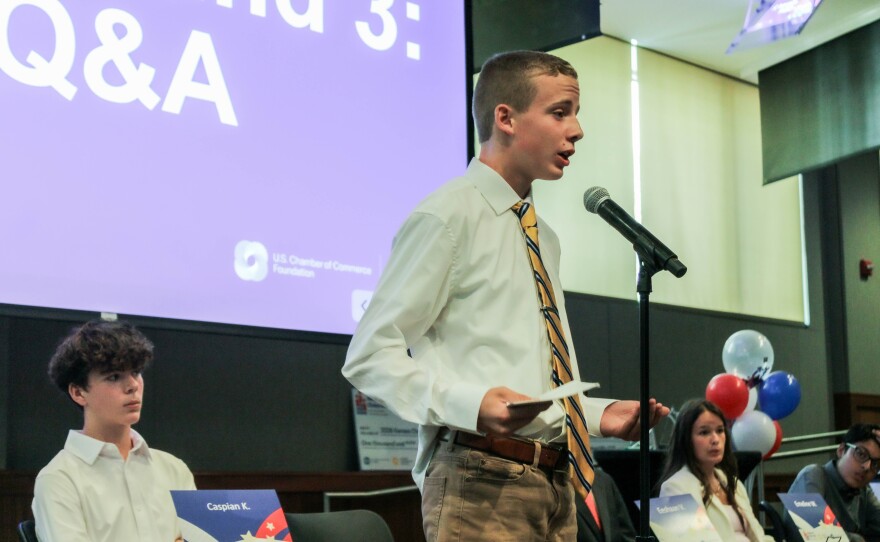
The whole process plays out again at the state championship level. Here, three finalists were selected.
Emeline Wilinski of Indian Hills Middle School in Prairie Village told judges coverage of a city election last year highlighted record-breaking voter turnout. Wilinski said that turnout still accounted for only 25% of registered voters in Prairie Village.
“This isn’t because members of my community don’t care about their city,” Wilinski said, but because of a variety of issues like shifting election timing, lack of information on ballot issues and a general sense of disenfranchisement.
“When so many voices are missing from the voting process, the crucial principle of consent of the governed is weakened,” she said.
Wilinski proposed ending off-cycle local voting and said she’d work to create a club at her high school to prepare students to be informed and engaged voters as soon as they turn 18.

Caspian Karstens, a California Trails Middle School student from Overland Park, pitched a nonprofit transportation system specifically for low-income and homeless Kansas Citians.
His proposal was to design an independent bus system that would have central pickup hubs and routes to local hospitals, care centers and pharmacies to make health care more accessible.
Colin Burke of Salina South Middle School focused on providing his classmates with basic hygiene products. In Colin’s district, nearly 17% of families live below the federal poverty level.
Colin told judges that by providing no-cost hygiene products in school buildings and city buildings he hoped to meet his goal of “a school where every student feels confident and that their basic needs are met.”
“Teens will be much more successful in and out of the classrooms if we do this, because by treating teens with dignity and respect and encouraging them, they will in turn give back to the community that gave to them,” he said.

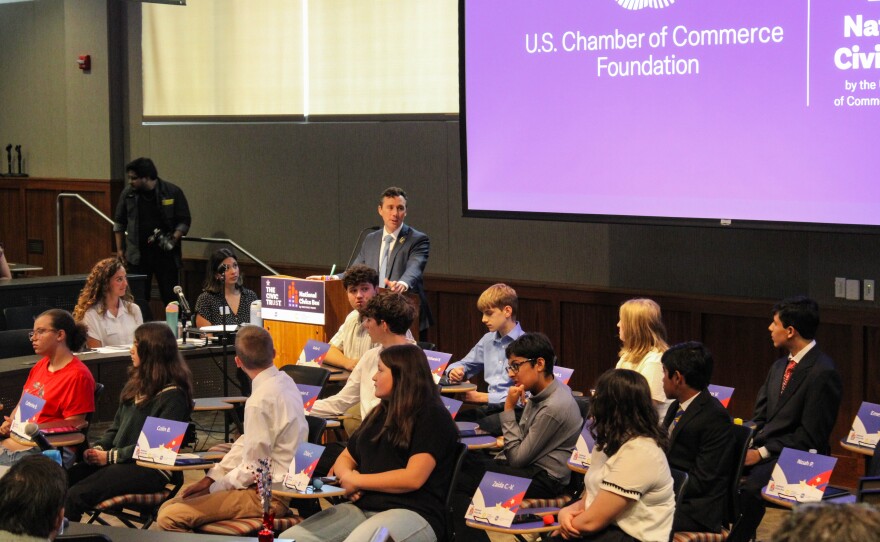
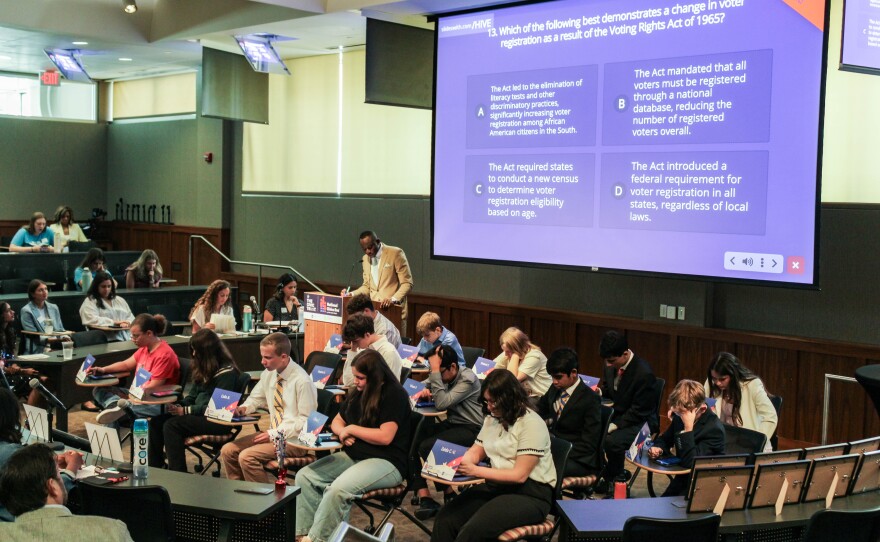


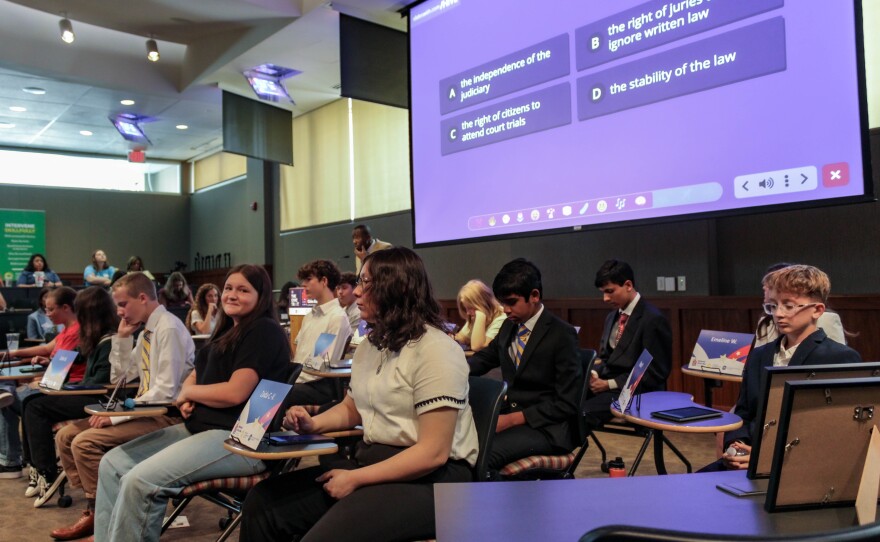

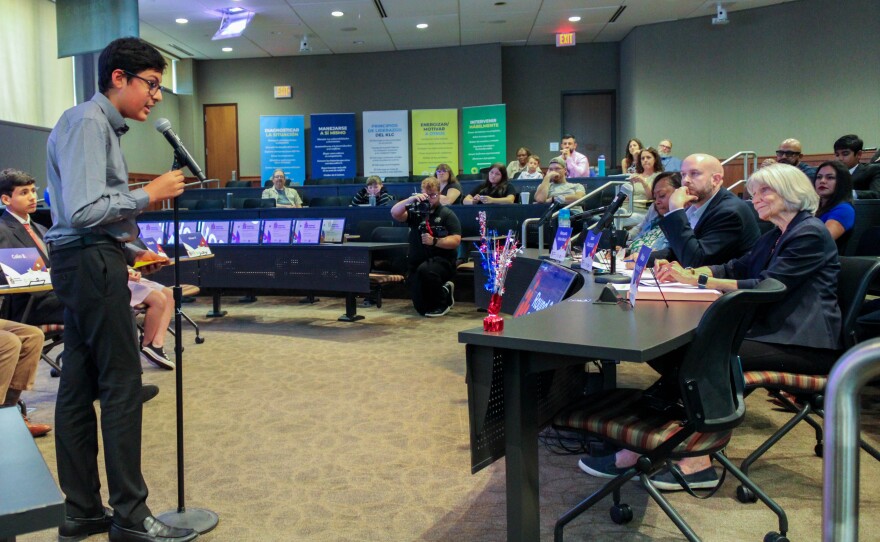


Judges awarded Colin the first place title — which comes with $1,000 cash and a ticket to Washington, D.C., for the final this fall. Wilinski took home the second place title and a $500 prize. Karstens placed third and was awarded a $250 prize.
In the wake of the competition, Colin said he was still shocked to hear his name called as the state champion. There was less surprise from Colin’s proud parents Brendan and Elizabeth Burke, or his younger brother Liam.
“He’s been just so civics-minded since he was a toddler,” Elizabeth Burke said. “I knew that this was something that he was destined to potentially do.”
“He’s just someone who wants to help,” Brendan Burke said. “All his teachers talk about how they can put any student with him, and he’s willing to do that. So helping kids who are hidden and fall between the cracks is something that’s not terribly surprising.”
Colin will travel to Washington, D.C,. later this year for one last trivia and pitch competition. A win at the National Civics Bee would mean a $100,000 contribution to an education fund — and a major confidence boost toward tackling the problems of the day.
For some of the audience members at the Kansas championships, the true prize has already arrived.
“Their commitment to good citizenship in America makes America proud,” said Ernestine Krehbiel, president emeritus of the Kansas League of Women Voters and a former Wichita school board member.
“And in this time in which there's such negative vibes floating around all over, this is such a wonderful thing to do. What a way to celebrate 250 years in America.”
