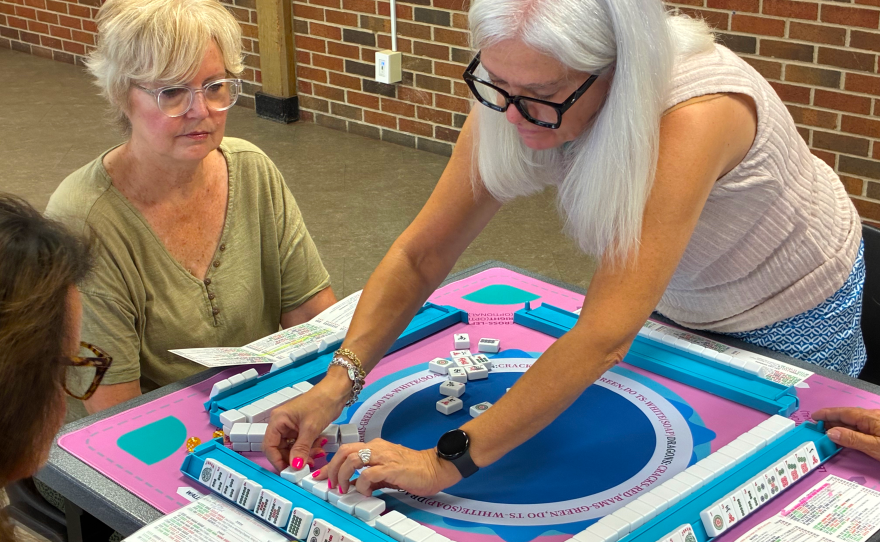
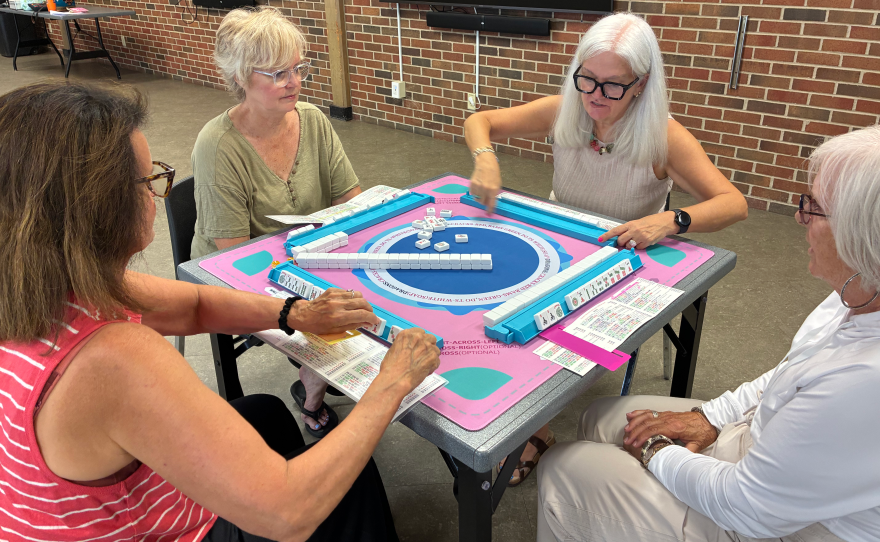
On a Saturday afternoon at Edgemoor Park, a group of senior citizens gather for a beginners’ course on American mahjong.
Tracy Callard is leading the class while participating in games at the same time. As she tries to form a good hand, students will raise their hands to ask for advice about the gin-rummy style game.
Developed in China in the 1800s, the game of mahjong found its way to the U.S. in the 1920s when it was brought over by Standard Oil executive Joseph Babcock.
“Babcock adapted the game,” Callard said. “He had this great idea, ‘I'm going to sell this in the United States.’ So in 1923, he got a patent, and just like Trivial Pursuit was super popular in the 1980s, in 1923 under every Christmas tree was a mahjong set, and that's how American mahjong started.”


It fell out of popularity as the 20th century went on, but was kept alive by a devoted group of fans throughout the years. Callard started playing the game when she was a teenager at sleepaway camp.
“It was a rainy summer,” Callard said. “There were about probably 15 to 16 girls in our group, and the counselors did not know what to do with us. They were Jewish women from New York City, and so they decided they were going to teach us mahjong inside the bunk, and that's how I learned.”
While it was slow to take hold in America, Mahjong has been part of everyday life for people in China and all over Asia since its inception. The game only started picking up steam in the U.S. over the past decade, particularly after the release of the 2018 film Crazy Rich Asians.
In the years that followed, more and more Americans showed interest in the game.According to Yelp data, searches for mahjong clubs are up almost 4,500% since last year.
Hallmark even developed its own mahjong-themed romance film titled “All’s Fair in Love in Mahjong.”

During the climax of the film, the love interest gifts the protagonist with a mahjong set.
That set was designed by Wichitans Betsy Farha, Morgan Sandifer and Anne Marie Garland, who are collectively known as Miss Mahjong. Garland and Farha were extras on the film as well.
“Seeing your tiles,” Garland said, “on a movie set with all these actors and actresses coming around, and just learning the game, and being like, ‘Wow, I can't wait to go home and teach my daughter this game,’... it was just so sweet.”
Miss Mahjong also designs and sells their own sets. You can find them online or at local retailers like Love of Character, which is where Sandifer’s group plays as part of The Green Table Club.
“Mary [Billings], who owns Love of Character, is a good friend of ours,” Sandifer said, “and so we've been a part of that, and that's been a really fun opportunity, because we've met a lot of wonderful women that way. That's the league that we've played.”
She said the game has also found its way into her kids’ school, just not in the hands of the children.
“A lot of the teachers will play, and so I'll go to events and hang out with all of my kids' teachers, and that's a really fun thing too, just like unexpected time with people you maybe wouldn't have had before.”

American mahjong gatherings have popped up all over town, from places like Botanica to the Candle Club.
But what about the traditional game? What makes American mahjong different from Hong Kong mahjong?
There are a number of things. The American variant requires a reference card that changes every year. Americans also have an extra phase called “The Charleston,” where players swap out tiles they don’t want. In addition to these changes, the tiles are thinner and include extra tiles as jokers.
“With Hong Kong mahjong,” Stanley Chung said, “you don't have the jokers that can replace the other cards or the other tiles that kind of deal to complete the set or to complete your hand.”
He mainly plays, and from time-to-time teaches, Hong Kong-style mahjong. For him, it’s always been a game about coming together.
“It’s more of a gathering, and then the playing … is secondary,” Chung said. “When you play mahjong, it's always four people, four person to a game, and then that's where the interaction comes about. And of course, [there’s] a lot of catching up, or maybe talking about, ‘Hey, what's going on with life,’ … that kind of deal.”
Regardless of the variant, the appeal of mahjong is the communities it can help create and the time spent with people playing the game.