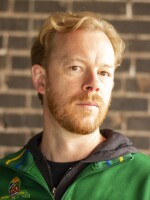
Blind musician Charlie Wilks describes his experience with sound and what he hopes to
convey in his newest project as a “thunder” with a “shimmering light experience.”
“One of the big challenges with art museums is that it's quite frequently mostly visual art,” Wilks said. “[We are] trying to step into this realm of how do we make it a more inclusive space for people who can't see.”
Wilks agreed to provide sound for still images in the exhibit, giving visually impaired people a more complete perspective of the exhibit.
“They called me up and said, ‘Hey, we've got 10 paintings, and we'd like you to make soundscapes that are representative of the paintings.’”
Working with his girlfriend Alison Roets, they started with how the paintings could be portrayed verbally, and then mixed that with sound.
“Because I myself am blind, what are the sounds that I would hear as a blind person in this situation? And then I just tried to create that,” Wilks said. “It was almost like taking a still image and turning it into a moving image.”
His next challenge would be finding representative sounds.
“How do I create the sounds? The most challenging pictures were … wide open desolate landscapes. As a blind person, the only thing you would really experience if you were standing in one place was the ambient sound of the wind around you,” Wilks said.
Wilks found human clues in the paintings to create sound around.
“There were pipes in the picture,” Wilks said, “and let's just imagine that there's wind happening in this scene, like would the wind blow over the pipes and make a noise?”
So he invented how to recreate what that sound might be like.
“I went and got a metal straw and recorded myself blowing over it,” Wilks said. “And then just dropped it a few octaves. It was pretty convincing! That's like one of my favorite things I got to do was mess with everyday objects and figure out how to process them to make them sound like something it wasn't.”
Perspective had to be accurate to the experience. Wilks plays an interpretation of “Against The
Rain” by Zoltan Sepeshy. He imagined being in the painting and what it might sound like, hearing the organ from outside the church.
“I was trying to take the third-person viewing experience and turn it into a first-person audio experience,” Wilks said. “It's like you're standing, you're standing outside the church, maybe up on a hill, and you see … the church, and then to the left is the tree, and to the right you see the horse, and then how that would sound if you had an exaggerated stereo field.”
Wilks says that’s how visually impaired people experience much of the world around them.
“That's kind of how sound works, right? It's very spatial for us,” Wilks said. “So my focus was on creating accurate spatial representations of the descriptions.”