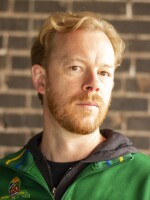
Artist Sloane Dyer shows me her work at Harvester Arts with two classmates, painter Madison Mullen and ceramicist Branden Lawless.
“I think the night that I passed my defense,” Dyer said. “I got the best night's sleep I have in probably three years.
“We all passed before the show opening. Branden, Madison and I were all feeling that way, and it was just this big celebration of everything we've done, and I think everybody who came felt that too.”
The show was hung before they knew whether or not they passed. Dyer’s defense was at the beginning of April, and she says it was no joke.
“Three full-time faculty members and up to five people,” Dyer said. “They all come in, you talk about your work, they read your artist statement, they see how you've put your work up and then they grill you for what's supposed to be about 20 minutes, but it ended up being like 40.”
Dyer’s paintings are not taut on a frame but wadded or crumpled, forming slopes and crevices away from the flat wall.
“They extend from the wall, kind of three-dimensionally, and cast shadows,” Dyer said. “And some of the backs of canvases are painted on as well. I paint all my paintings on stretched canvas, and then I rip them from the canvas as a way of releasing them from colonial ideas.
“That's what you hear kind of in the background, is the stapling and the ripping, because the deconstruction is as important as the reconstruction of my work.”
Dyer’s grandfather, Dr. Vernon Dyer, helped Black Bear Bosin put up the Keeper of the Plains and started Hunter Health Clinic. Sloane wants to reframe how people think about native art.
“I feel like a lot of people think that native art needs to be historical or ledger art or patterns, and I mean mine is in a way, but it's not what people think of it traditionally,” Dyer said. “So I kind of want to reimagine what native art could or should be.”

Branden Lawless is showing his ceramics down the hall from Dyer’s works. Lawless is world building through his specific lens that involves conspiracy, mythology and many other influences.
“These works showcase more of like the personalities and how they are connected to the central figure, which is ban or myself through my lens as someone who has grown up in the Midwest, who is Catholic and who is queer, so I have a lot of like juxtaposing beliefs going on within my life. So that's why this work also takes on this rebellious, sort of grunge aesthetic.”
The scale of the work is like walking amongst human-sized cartoon characters. The thesis of Lawless’ show is titled “Rat Bastard University: Home Sweet Home.”
All the characters are facing the artist's likeness in the center. There’s a whimsy amongst the main character's anxiety.
“I had a private showing for the president of [Wichita State University] and his husband,” Lawless said, “and they used the word ‘sophisticated.’ I was really surprised. I've never gotten the word sophisticated for my work.”
Looking at one of his works, Lawless describes one of the characters on display.
“She's a poison dart frog,” Lawless said. “And her spots are similar to fish nets or pantyhose in some way.
This creature represents a friend, a relationship. All of this work represents a relationship in his life. Many of the characters were made into action figures that are also on display.
“It was really cool to see at the opening, people walking around with the art and the merchandise,” Lawless said. “And I think that influenced more people to pick it up.”
The action figures are ceramic and handmade by Lawless, and so is the packaging.
“I'm also cutting out all the boards,” Lawless said. “I'm using the plastic vacuum form to make the actual bubble blister package that's on there. I'm digitally designing the graphics on there, and printing that off, and constructing everything together. So everything on the action figures is made and constructed by me.”

Lawless work feels kinetic. At the opening, there was a broken piece on the floor that seemed intentional. Lawless accepted what happened and embraced the accident.
“I don't see a permanence to everything,” Lawless said. “And I work quickly, so I'll just make another one.”
Lawless went to Derby High School and had an encouraging teacher named Natalie Brown. She urged him to work on his own, which has given Lawless many years to perfect his craft.
“She was really encouraging while I was in high school, and let me take clay home,” Lawless said. “And so I've been doing sculptures like this size for almost 10 years now.”
Lawless hopes to build more of his story now that school is over — and not necessarily through ceramics.
“I would like to keep developing this body of work in some way, and I don't think it will necessarily be through ceramics,” Lawless said. “I can see myself nailing down this narrative through comic books or paintings.“
Correction: A previous version of this article had Sloane Dyer and Branden Lawless' names misspelled.