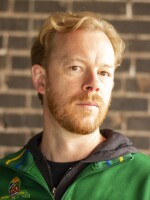
If there is one thing artist Lindsey Lord misses, it’s being able to gaze at the heavens.
“I am really sad that I can't see the stars anymore, but I do feel them,” Lord said. “That is true. I'm not being poetic. I really feel that.”
“This work is dedicated to the stars, which I can no longer see, but which I can feel,” is Lindsay Lord’s dedication under her show title, "An Infinite Container.” She is losing her sight but not her vision.
“I have retinitis pigmentosa,” Lord said. “It is something I was born with. It runs in my family. It affects my peripheral vision and night vision. So I have very strong central vision, but it is very restricted to the point that I am legally blind. One of my doctors said that it's like looking at the world through like two paper towel tubes.”
Lord’s mother studied early childhood development and noticed how advanced Lindsay’s drawings were from a very early age.
“Around the age when children are not even putting fingers on their drawings, I was putting things like cleavage and like double chins and just noticing details and drawing them that were advanced,” Lord said.
Lord said she was obsessed with drawing. That focus still translates.
“I still hyper focus for long periods of time, and I'm very concerned with detail and complexity,” Lord said. “The activity itself has changed, but the way that I'm spending time isn't that different.”
However, the materials are different and that helps Lord weave a new way of expression.
“These are textile works, the medium is very different — and not just physically different, it's different metaphorically,” Lord said. “There's a lot of meaning embedded in textiles, and I think that for me, the medium sort of dictates the types of things that I want to do with it, because of the embedded meaning, because of the history that it carries.”

She said we’re taught to stand back from a drawing and not touch it. The reaction to textiles is much different.
“Quilts and textile work are really inviting to the viewer,” Lord said. “We have a rapport. Our bodies have a rapport with textiles. We're wearing clothes. We're always touching something soft. They just want to touch the work, and nobody ever wants to touch your drawing or your painting.“
A quilt can imply comfort, something this exhibition is not all about.
“Parts of this are about catastrophe and moments of devastation, and also about how to get through that,” Lord said. “Yes, it's about my diagnosis, it's also about just the moment that we're in the world.”
Much of this exhibition literally reads as poetry. Lord explores ecstasy and misery in one statement.
“I love Khalil Gibran. He wrote The Prophet. It's this book from the 1920s it's like a narrative poem,” Lord said. “There's a chapter about sorrow and joy, and there's a line where he says, “The deeper that sorrow carves into your being, the more joy you can contain.” [crying] And I really feel that. So it's both. It's like the container of grief is also where you hold joy and hope, if you choose to.”
Lord looks to her community to find joy. She is hosting an artist talk during the solstice, December 21, at Fisch Haus and asks people to stick around and “wiggle” with her.
“I think around 7:30 we're gonna have an earthworm dance party,” Lord said. “It's really easy to feel overwhelmed and powerless and depressed and to isolate. So, as an antidote to that, at the earthworm dance party, we're going to do this collective spell where we channel the energy of earthworms and have a great time wiggling around and just feeling good and dancing and basically building community.”
And sometimes the critical work of making the world a better place is best executed with friends having fun.
“You know, sometimes the best things we can do to make the world better is really get together and have a great time and see that as really crucial,” Lord said. “It's not light, it's not unimportant. It's radical work.”