Amyotrophic Lateral Sclerosis, also known as ALS, affects motor neurons in the spinal cord, resulting in muscle weakness.
Though being an artist is often associated with an emotionally sensitive and grand-thinking mind, the body also helps in the process of creating art.
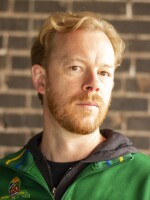
Jack Wilson has been painting and drawing his entire life. However, that creative process is more challenging now after he was diagnosed with ALS in 2011.
Wilson lives in a Wichita assisted living facility surrounded by his work in his personal room. But sometimes he ponders how his own work differs from what’s in the halls.
“I was even thinking, ‘I wonder if they'd let me hang stuff out there,’” said Wilson. “What is hanging out there is so considerably different than what I would do?
“I don't consider myself a decorative artist, and I think that's what they're mostly interested in is safe bets.”
With his wife, Rhonda, by his side, Wilson explores what art has meant to him as residents are wheeled down the hall just outside his door.
“Basically meditate to investigate ... the world myself,” he said. “It's more of an interaction, a play between ... my psychic and [what’s] in the materials. I think of it as spiritual. It's connecting into something beyond the five senses.”
Creating any work of art can leave the artist feeling like the work is never complete, and for Wilson, one particular piece is truly never done.
“I threatened myself back in the ‘70s just to do one painting the rest of my life, a big canvas on the wall,” Wilson said. “I thought I could add and subtract and just continually work on it.”
Wilson places more of an emphasis on the process than he does on the end product.
“For years before school, everything I made, I threw away,” Wilson said. “I didn't keep it. It was, for me, the experience in the play, the investigation. All anybody has is 24 hours a day. That's all that you have of real value. And how you spend those minutes counts. And if you're spending them doing something to make money, and that's all you're getting out of it, you're selling yourself short.”

Wilson said he didn’t intend to pursue a life in art, though his primary income to support his family came from an art-adjacent enterprise.
“I made my living primarily as a picture framer,” he said. “You're not an artist, but I still got to pursue art on a lot of different levels, by the people that brought stuff to me. Because of my background, people would ask me to critique them. I got to be a little bit of an educator, which I enjoy sharing and teaching.”
Despite limited physical movement, Wilson stays busy with photo restoration for his clients since moving into an assisted living facility at the end of the most recent summer.
“What I used to be able to do, [I did] real fast,” Wilson said. “Now it's incredibly slow, but I'm happy that I'm able to actually produce something that brings some kind of joy [and] satisfaction to a client's life.
However, Wilson said he is not fond of calling his work “art.”
“I like to think of myself as really a maker,” he said. “Public…they can call it what they want. They can call it art or, you know, my junk.”
The one thing Wilson does miss is the ability to make his own so-called “junk.”
“It's a little bit of a mourning process, where I mourned even though I haven't lost my life,” Wilson said. “I'm mourning the loss of some of the stuff that I used to do, or mourning the thought of losing my kids, my wife, my family, friends, which are way more important than art. But I haven't lost them yet.”
Despite everything he has gone through, Wilson has not lost his sense of humor.
“I mean, there's hope for heaven/something better,” he said. “I hope I see my dogs there. I'm not taking my junk to heaven with me.”