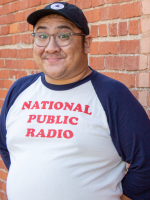
Following the release of her new album "Halo," Tiffany Day is having a moment. Over the last few months, her music has been covered by Pitchfork, NPR Music and the LA Times. The twenty-six year old is among a growing group of young women who not only write and sing, but also produce their own electronic music. Day's latest efforts evokes the sounds of hyperpop, an EDM subgenre that draws heavily on glitchy synths, aggressive bass and y2k aesthetics to produce pop music that is maximalist in every sense of the word. However, what Day adds is a degree of intimacy in her confessional lyrics layered over euphoric flourishes. Day is also a Wichita-native through and through. KMUW’s Hugo Phan talks to Day about her hometown, sold out shows and new album. A transcript of their interview has been included below.
This interview has been edited for length and clarity.
What was it like growing up here?
I feel very grateful that I had the opportunity to grow up in such a quaint, nice town. I think there was something about it that maybe helped shape me to be a little more bold and to want something big. Like, I could imagine if I grew up in a huge city like New York or LA, things could be different. But I think there’s something about starting small, and then leaving a small town feels so much more life-changing and exciting. So I had a really good time growing up here, and I felt like I had so many aspects of my childhood that were just perfect. So I love Wichita.
What are some of your favorite places in town?
I used to work at Cocoa Dolce in high school, so I would say I still like to go back there to have some chocolates.
Do you have any favorite Wichita landmarks?
I really enjoyed always taking a lap around the pond at Bradley Fair. That was like, so pleasant.
There's this area near our house that I grew up calling gooseland, or geeseland, and … [at] a certain time of year, there's just like, a lot of geese, and then you just walk out, and they're everywhere.
I remember one place I would go to a lot was The Donut Whole. Is it still up and running?
It closed a couple of years ago, unfortunately. The chicken is still there on top of the building, though. Their tiger mural was iconic.
That's so sad! I had my first ever, I guess you could call it a show, at The Donut Whole. I emailed them, and I was like, “I'm a musician. Can I come and play music?” And it was just me, a microphone, my acoustic guitar and 10 of my friends that showed up. And I just sang more covers at that time because I wasn't really writing as much original music. But I just, I think I still have pictures from that day. It was so cute, and I'll always remember The Donut Whole for that day.
How does being from here inform your music?
I am an Asian American, and obviously, I think there's been more diversity now as time progresses, but when I was growing up, I feel like there still wasn't a whole lot of diversity. And so it was this interesting thing of trying to find who I was, figuring that out, at the same time, also, trying to be confident in not knowing, you know. And I think it took me a while, but I feel like that experience in itself helped shape who I am today and how confident I feel in my skin.
And also my most recent album that just came out, “Halo,” is actually quite inspired by a lot of those childhood feelings and ways that I felt growing up in Wichita. So, I honestly I don't even want to talk about it necessarily in a negative light, because I don't think it was a negative thing, I genuinely think it was like a beautiful thing for me to experience. And I know that there's so many kids all over America, in many different other cities, not just being Wichita, that probably felt a similar way. But I feel like it was a beautiful thing to be able to experience that and then translate it into art, and then be able to have other people relate to it, you know.
I can't imagine growing up in literally any other town. Like everything that happened to me, everything that I felt, and that's not to say Wichita didn't celebrate me, I remember I did Riverfest, and they had a volunteer program called the Schooner Mates, I was a schooney! And so I remember that time. There are so many beautiful things to love and celebrate in Wichita. I think, honestly, like, I couldn't say anything negative at all. I think I owe a lot of my experiences in the way I feel now to growing up here.
I'm a Vietnamese person, and I grew up here. My parents are immigrants. I went to Goddard. I was one of the only Asian kids, and that was not long before you. So I can relate to your music quite a bit. There might be cultural barriers here at times, but we find ways to bridge them. There are also more and more Asian American pockets developing here.
I totally agree. Everybody has always been so sweet, too. I think it's something I reflected a lot on. It's more just the idea that you feel different growing up. So there will always be something in your head that tells you that you're different, even though, I think, the environment that I grew up in, like no one bullied me for being Asian, you know, it was very much like I was still, you know, included and seen and heard, but it was more just that thing of, “how can I handle this internal narrative that I feel all the time? Of like I'm different?” Because I think it's one thing to feel that when you're like 25, but it's another to feel it when you're like a 13-year-old girl that doesn't really understand what it means to be different. But again, I think it's beautiful that I did feel that. Because without that, I don't think my art or the things that I write about would exist the way that they do.
Did you have any interactions with the local art scene while you were living here?
I actually feel like I wasn't that involved, but I think it was more because I just didn't know how to be involved. My oldest brother was in a psychedelic rock band when I was young. He wouldn't tell me the name of it because it was an inappropriate name, and he kept saying, “I'll tell you when you're older,” but he was way more involved. I think there was just the whole network of Wichita musicians that kind of knew each other, but I think I was too young, really, to do that. And then as I got older, I think a lot of it became all “on the internet.” And so when I started posting my covers in high school, I used to sing covers on YouTube, …[and] a lot of that … went straight towards the internet. I also didn't start really writing or taking original music seriously until I left Wichita and moved to Los Angeles. So I'm sad that I wasn't as involved in the local art scene.

Which kind of brings me to hyper pop, and how it’s a regionless genre, right? It traces its origins back to the internet, which is in itself regionless. You can be from anywhere. At the same time, the internet also informs a lot of its aesthetics and sounds. Tell me what is appealing about hyper pop, especially to somebody from Kansas, which is not what you think when you think of when you think of the genre.
I think I've always been a very big fan of electronic music that makes you feel things. I think growing up, I listened to a lot of Wethan and he was kind of my gateway artist into the whole genre of future bass in the 2010s or something like that. And I got really into [running] this editing page on Vine at the time when it was still an app, and I would use a lot of these electronic songs. And I just got really into the idea of … the way a synth can be made, that just makes you feel something, the way it's like, the whoosh of it, you know, or the notes, or the tension, or stuff like that. And I think I really fell in love with that. And then I think, at least for me, I can really hear it in my last project, because I was very intentional with how I had produced out some of these really big drops, but I just wanted to prioritize that feeling again, and also not sacrifice who I was before I kind of started fully making the switch into hyper pop.
Like, I really started in pop, I learned how to write music with a guitar, and a paper, and a pencil. And so there was something about it where I didn't want to give that up. And I still think that's a very big core part of who I am. And so I think, I think genuinely, the two components that make me feel music the most, which is one, a really good topline and really, really good lyrics and a melody, and then two, the production just being something that tonally feels so emotionally capturing, and … encapsulating, you know? And so I think combining those two things together kind of became the result of “Halo.”
What are the logistics of touring and coming to Wichita? Also, why might that be hard? I know it's hard to come here for certain artists, because there’s the incentive to sell out, right? Sometimes it’s hard to get people to turn out for things in Wichita.
Of course, the whole incentive of “Oh, we want to sell out the show,” is obviously a big reason that I think agents will probably overlook Wichita.
I don't know. If it were up to me, and if it wasn't about the numbers, I would pick Wichita every time. But also, I genuinely have no idea how many people in Wichita actually like me? So I'd be very curious one day to do a headline show here. I just don't know how many people are going to show up.
That's completely understandable. I mean, I've been to many shows where it’s been half full. I was at one show recently where I was standing in the back, and the manager went, “We've sold out in every city. I don't know why we didn't sell out here.” I was like, “I'm sorry.” But I've also definitely been a part of a lot of small but mighty crowds.
I'm sure that eventually, when I do a bigger North America run and we start hitting a bit more of the smaller cities in the Midwest, I'll probably push to have Wichita. Like, I don't even care if it's not sold out, because I've been through it. I have done shows where it was half, maybe not even half, maybe, like a third sold, and at the end of the day, I know people focus a lot on numbers, and they're like, “Oh, we sold this out. We sold that out.” But it's also like 100 people on a piece of paper is so much different than 100 people in a room. And you really feel the energy no matter what. And it's like people showed up, and it's really sweet. So I would like any day of the week, I feel like, as long as I could play for people who grew up in the same place that I did, and, you know, like, I would be happy. So I'm sure when I do, like, whatever next big North American tour, I'm definitely gonna push to have Wichita on it.

Tell me about your evolution as an artist, and how you kind of got to “Halo.”
Well, I grew up here. When I was 17, I went to Italy, and I sang into a well. I went with my school choir called the Madrigals, and they do this trip every two years, and then we learn songs in Italian, and then we sing in cathedrals. And then I sang it into this well, I put it on Twitter. It went viral. Within the week, my mom said it's time to capitalize, and we made a YouTube channel. So then I started posting covers on YouTube, and before I knew it, by the time I had graduated, I had like 500,000 subscribers. So at this point, I was like, “I gotta move to LA.”
And my parents were not that happy with my decision, but they're very supportive, and so they said, “you can go to LA and go to college and then do music at the same time.” I said, “Okay,” so I got a good scholarship. I left for LA, and for the first two or three years, it was really about building who I was as an original artist, because I had spent [a long time] doing covers.
I started making bedroom indie pop at first, because honestly, that's all I knew how to do. Like, I grew up listening to a lot of future bass and electronic, and I've always loved that genre as a listener, but I never really thought I could be one to make it, because I have tried. Like, there are secret tracks that I will never, ever, ever come out that I made when I was 14, 15. (laughs)
Fast forward a couple more years, and I'm starting to kind of make a name for myself in this, like, indie pop space and world. I have a couple of pretty good streamed songs, and then I came up with my debut album, “LoverTofuFruit,” and that genuinely is probably the most miserable I've ever been in making music. There were songs on that project that I would make and then come home and cry about them because I hated them so much, or I just didn't think they were good enough. And then somehow they made it on the album, and they were out in the world. And it was a weird time too, because that was my first album ever, so I didn't really know what I was doing, you know? And then I think on top of that, it was just this thing where I was kind of having this weird identity crisis, I kind of fell back in love with electronic music in college, my friends took me to my first rave ever in Vegas called EDC (Electric Daisy Carnival), which is crazy, because I'm going to play EDC this weekend, not a full set; I'm popping out for a friend’s set, but still very exciting. It re-sparked my love for electronic music. And so there was a point where all I was listening to was heavy bass, dubstep, like all this stuff. But I would still go to sessions and write pop music, and I would feel very miserable because I was just like, I hate this. I hate this.
And after I finished “LoverTofuFruit,” it was upsetting, because originally my plan for this album was for it to be half indie pop, leaning [towards] what the people love and wanted at the time, and then half like electronic, more influenced, kind of inspired, like hyper pop. And the toughest part is that nobody really bit at the electronic ones, and those are my favorite ones, but then everybody loved like, “hellaboycrazy,” which was like a super indie pop one. And they loved all the indie pop. And it was very frustrating, because I just felt so trapped in this box. Like, my top-streaming song at the time was a song that I hated. And I know they say the thing about like, respect where you came from, which I do, I sincerely do, but it was just tough, because I just felt like I wanted to grow and I wanted to change, but nobody wanted me to, and so I had this really awful relationship with music where I just felt like I was done. We had all graduated college at this point, all of my friends started getting their 9-to-5s. They were making their stable checks every two weeks and getting their health care and all this stuff. And I was sitting back like, “oh my gosh, I'm like, actually going broke. Like, I don't know, like, I don't know what I'm supposed to do right now, and I'm not happy making music either.”
And so I basically had, like, a very serious conversation with myself, and I told myself, “maybe this might be the last album, but if it's going to be the last album, then maybe it's something that needs to genuinely make you happy.” Like, maybe it's time to just completely stop thinking about what streams the best, and you know what's gonna make your fans happy? And just make songs that make you feel good, and make music that you are proud of. And I think this new kind of wave of really cool artists, like, I remember I found Ninajirachi.
I saw her in Lawrence in March. Sold out crowd. It was crazy.
She is awesome and just so inspiring on so many levels. And I think it also made me realize, throughout the last [few] years, I've been slowly learning how to produce ever since I moved to LA, and then around the time when I really hated my pop music, I was actually making dubstep on the side. I had a whole project called monolid where I would go to these underground raves and play and produce dubstep. And so I think there was a point where I’m just gonna do what I want to do. And so “Halo” was made, and it was scary because we rolled out the first couple singles … and they didn't do well at all. And I felt like, “Okay, this is really the end for me.” Like, it seems like nobody likes this music, even though I loved it. But I was like, “it's not gonna make me money, though. And then how am I supposed to live as a human?” And something happened last year around, like November, it's because I wanted a Dyson Air Wrap, and so I made a deal with myself that if I could post 30 days in a row, every single day on TikTok, doesn't matter how well the videos did, it wasn't about the likes or whatever. It was just about the consistency. If I did that, then I could get my Dyson Air Wrap. And I did it, I got the Dyson air app, but on top of that, it just took off. Like, I just by the end of that month, I had 50,000 new TikTok followers, and I signed a record deal. And at that point, it was just like, the momentum just kept going. And I was like, “Okay, I'm just gonna keep it going.” And then "Halo" came out last month and here we are. I'm sitting chatting with you. It's really crazy. And I'm just, I'm excited to keep making more music, and everything feels great, almost like a little too great. I'm like, what's the catch? You know?
Tell me about your new music video for “No Luck,” and tell me about the inspiration for the song.
So it's funny, “No Luck” was a song that I wrote before all the virality started happening. It's maybe one of the older songs on the album, and I wrote it when I was feeling I was at my last straw. Because I wrote it when I was so down bad. I had an ant infestation in my apartment. They would not leave me alone, but first they came to my kitchen, I got rid of them there, and then I was an idiot, and I left a bag of Sour Patch Kids from the movie theaters in my purse in my closet, and I was going to a Dodgers game one morning, and I was like, “Oh, I gotta grab a purse.” And I look through, and I see one ant, and I'm like, “Oh, that's weird.” And then I come back, and it's just like … so many ants, and they were right next to my bed. So then they started getting to my bedroom. And so I was depressed that week. I was sleeping on the couch. I was terrified, and I just … I wasn't happy with the ants. I also had just started some new medications, and I think it wasn't even the fact that the medications themselves made me depressing, but it was the fact that I had to start medications because I think, you know, mental health medication is such an interesting topic. I think the youth is making it a little less taboo.
It's just tough because I felt this frustration of “why do I need pills to function?” But the reality is I have a little bit of OCD, and it can be tough sometimes to function without pills. So sometimes you gotta do what you gotta do. But at that point, I was very frustrated, because I was just like, “Why can't I just be a kid again and not have to deal with paying my own rent, but having these ants take over and taking this medication that I don't want to take, but it's supposed to help me function.” And I also just felt very tired. It was quite literally my “I want to give up song.” There's a line about my mom in that song. The first verse says something like, “No one would really care if I quit,” because it really felt that way, like I felt like I had been forgotten, except my mom, she'd be pissed. She wouldn't actually be pissed; that was just me saying the line. She's very supportive, no matter what. I think when I was saying “she would be pissed.” I was saying it more in the sense of “I literally poured like, eight years of my life to this career, and all of a sudden I'm like, ‘peace out.’”
That being said, the music video is a fun reflection on the messages of “No Luck.” But I didn't want to glorify drug usage. I think also because my audience is roughly my age, but also I think there's a lot of younger people too, so it's like, I'm not trying to tell you that it needs to be a romantic thing to, taking medication, because if it were up to me, I wouldn't, you know? It would just be nice to not think about it, you know. So we used sprinkles instead of actual pills in the music video, which is actually kind of funny, because I guess it is a little bit romantic, but it's not like that. You know what I mean. I think we just wanted to keep it fun, light, and playful, and not too dark and heavy. And then I also had two of my buddies join me in the video, Emwell and Zuke. Zuke is this kid who runs this TikTok page, and he calls himself “the underground president,” and I totally think he is. He just makes really sick dance videos and cool commentaries about all sorts of artists in the scene. He has a whole interview series. He's kind of just like a personality in the underground. And they've both been so sweet and so supportive. And I was like, “it would be so fun to have them in the video.” So we flew them out to New York, and we have this really fun jump rope scene where we're trying to do double dutch on the streets, but it's really hard to do. But yeah, I think it's a really fun video, and a lot of the editing too, like me and Ally, my creative director, are the two that oversaw pretty much almost all of the creative side of it and stuff, but Ally and I edited it together, and it has very classic Tiffany Day glitch edits kind of thing in it.
You have a tour with Glaive, and also the “Halo” tour coming up soon. What’s that like?
I've always wanted to be an artist who could sell out a tour very quickly. And touring is not new to me. I think my tour/the Glaive tour might be my ninth or 10th tour, but I [also] remember my first or second tour, like my first big headline one. It was tough because tickets were not selling well, to the point where I had to cancel a couple of shows, and it was embarrassing. It's nice to have been through it. I think it would have been a different thing if I were an artist [who] blew up out of nowhere. I've never really done live shows before, and now I'm headlining, and I'm selling out 1000-capacity [venues] a night, but then it's like, I've never experienced what it was like to be an artist selling like a 400-room but only 100 people buying tickets. And I think there's something about it that teaches you how appreciative, and also just how proud you can be of yourself, to grow that much. I genuinely had no idea the “Halo” tour was going to sell that well. Like I knew that “Halo” is a bit hot right now. I think a lot of people like the project, which I also didn't expect, either, but I just didn't know there would be that many people.
We went on sale with the tickets, [and] I was getting a massage in London. My manager was like, “I have one task for you today, and it's to be by your phone at 6pm when tickets go on sale.” And I was like, “You got it, Sammy,” and then I got a massage, and then I got out of the massage, and Sammy is calling me, and I was like, “Oh my god, I forgot.” But I think the crazier part is the original venue we had booked for Washington was 400 people, and it's funny because I actually played that venue two years ago on my very first North American headline tour, and I don't think I sold it that well. I think I sold 150 tickets, maybe, and I was beating myself up for it, but it was still a beautiful night. Like I said, like 150 people on paper is like, sad, quote, unquote, but then when you go in person, it's like, “oh, so a lot of people.”
I was genuinely like, “Okay, I think we have a good shot at selling out 400.” That sold out so fast, they upgraded me to a 1200 capacity room. I was scared because I was like, “Oh, that's three times more, I don't know if I can do that.” And then that one sold out too. It really makes me take a step back. I'm like, “Whoa. This is actually a little more real than I thought it was gonna be,” especially in New York, they told me they would hold a second night just in case the first night sold out. So the first night sold out, and then we put up the second night, and then the second night sold out. My manager called me. He was like, “…this was not on our bingo card, but I think we're gonna add a third night,” and then the third night sold out, and that's just insane to me, because I just, I don't know, I just would have never thought in a million years that “Halo” would be the project to blow me up this big. But I am very excited.
With the increased capacities come bigger stages and more budget for me to play around with and make really cool shows. I just had a call yesterday with this stage director, and we're talking about what we can do to really level up the “Halo” shows. Because, for those of you listening who don't know, I actually am very involved when it comes to live shows. My first headline tour, I programmed the whole show. I programmed the lights for the show, too. I kind of oversee the whole run of it. And I feel like the show itself is like art too, you know? Like, it's fun to not just be, “This is song A, this is song B,” but let's make transitions. Let's make moments, you know? And so I'm just really excited because I have … a bigger budget now to make something really crazy, so I'm really excited. I can't wait. I'm tired, though. I feel like my whole year just got packed with touring now.
But then I'm also so excited for the Glaive tour. I got the offer a while ago, and it was so hard for me to keep it a secret, because he is genuinely one of my favorite artists. Like, if you look at my Spotify top artists, both Glaive and Kurtains are on there, and it's their joint album that they're touring. And so when I got that call, I kid you not, I bleeped my pants. I won't curse on here, but I bleeped my pants. Yeah, not literally, but I was just so … I actually cried from happiness. …This will probably be the first tour that I get to do support wise, for an artist that I genuinely listened to a lot. And Ash and I … we've met once or twice in person now, but I'm sure that we'll become better friends as the tour continues. But, we've already texted and stuff, and it's hard for me; I know we're both artists, sometimes it’s a little hard for me to not fan girl because he's the GOAT to me, you know? But I'm very excited for that tour too, and then I feel like I can drop a little hint, but I think we might be doing a tour outside the U.S. soon too, so that'll happen. And I'm very excited, but it's just a lot of touring, a lot of touring. I'm tired, but I'm grateful. I'm grateful.

I watched your documentary, and there you talked about not being able to sell enough tickets and then having to cancel. There is also a sweet moment between you and your mom in there as well. So it’s fun to see you grow from that moment to this moment.
I didn't think I would get to this point, and it is very crazy that everything kind of happened. I know my mom was very happy for me. She's told me many times that she's very proud of me and like both my parents are. It's crazy to look back and see that video, and the way that I was crying about the shows having to be iced out, and how I just felt so embarrassed. But again, it's that thing where I've been on opposite sides of the spectrum now. And if anything, I think it's also the experience itself that has taught me to be so much more understanding and also empathetic towards artists that you know aren't having their moment right now. Because I think one thing I realized is it's a cycle, and it will always be a cycle of who's hot right now, who's not. And if you're too focused on trying to keep that hotness alive, I just don't think that's the right way to go about it. I feel like it should be more … let's celebrate that we're here right now and then see where everything takes us in the next year or two. Because I could very much go back to, like, who knows? You know, maybe “Halo” does really well, but I'm like, “What if my next project is butt?” You can't always be too cocky that you made it at the top, you know.
Knowing what I know, and the feelings that I felt when I wasn't selling shows well, like, I look at other artists in those positions, and I'm not thinking like, “Oh, you suck.” Like I'm thinking, “I feel for you because I was there, and to keep your head up and keep going, even if you feel like … you couldn't,” because honestly, like in my heart, there was never once a moment where I was like, “Oh, I'm going to blow up.” It was more like “I'm in it this deep,” you know? I got to keep going, I don't know what else to do.
I feel for artists who are in that position, or were in that position. I think it's just kind of taught me to be less critical of people, because you never really know what stage of their career they're going through, and it's always a cycle. I won't be up here forever. All I can do now is be present and be grateful that I am up here and live in the moment for what it is. And then who knows? All I know is that I was okay with having to cancel those shows, and I was okay being that artist in that documentary, and I'm also okay now being the artist I am now. So I know that no matter what, I will be okay. And I think that's the beauty of going through that and being able to reflect on everything.
When you’re away from Wichita, what do you miss?
I miss the roads being so wide. I miss the fresh air, even though sometimes in the summer the air gets really thick, and in the winter, sometimes it gets really cold. I miss the seasons. I will say that, because in LA there's not really seasons. It's kind of just stays 70 and sunny all the time. I think I just miss the peace and quiet. I like hearing the birds in the morning. And I miss my dog. She is like my pride and joy. If I weren't traveling so much, and if I stayed in one spot, I would definitely convince my mom to let me take her back to LA, but I tried. I brought her over there, and then it was just awful. I felt so bad because I was leaving every weekend for a show, and she doesn't deserve that. And she grew up here in Kansas, so I feel like she deserves a nice, big house and a yard, and people that can take her on walks every day. But I miss her so much. She's getting old, too. But anyway, I think I just missed the peace. Like I said earlier, I think there's some sort of feeling where time kind of stops here, and it's just so nice to — even though technically I am still working when I come back, there's always something to edit, there's always something to work on — but even the fact that I get to work on it, like at home, on the living room, kitchen table or whatever, is nice.
Any parting thoughts before we end the interview?
I would hope that I would get to come to Wichita soon and hopefully do a headline, because I think that'd be very fun. And also shout out to KMUW, I grew up listening to this station from my mom's car. She would always put this on to listen to the news and some jazz, and I'd be laying in the back and very nostalgic. So it is very cool and full circle to be on here chatting about my music.