

5
Images
Crowds head to Winfield to smell blooming corpse flower
More than 1,500 people visited Southwestern College to take in the smell of a rare and blooming titan arum. The college last had a blooming version of the Sumatran plant in 2020.

Corpse Flower-5.jpg
Southwestern College in Winfield welcomed more than 1,500 people to the blooming of a titan arum. The plant is commonly known as the corpse flower and only blooms for about 24 to 48 hours. Two women sniff and inspect the flower, taking in the view of its inflorescence — cluster of flowers — and signature scent. (Meg Britton-Mehlisch / KMUW)

Corpse Flower-3.jpg
A woman plugs her nose as she smells the blooming titan arum in Winfield. The greenhouse at Southwestern College has nurtured this plant for 25 years. The plant, known as the corpse flower for its signature smell, began blooming on June 14. (Meg Britton-Mehlisch / KMUW)

Corpse Flower-4.jpg
A mother and two daughters peak in to the center of a blooming titan arum in Winfield. The plant, also known as a corpse flower, was nurtured to a bloom at the greenhouse at Southwestern College. The bloom is an inflorescence or cluster of blooms. Male flowers are the dark red trumpets visible to the crowds, while the female flowers hide in deep the center of the cluster. (Meg Britton-Mehlisch / KMUW)
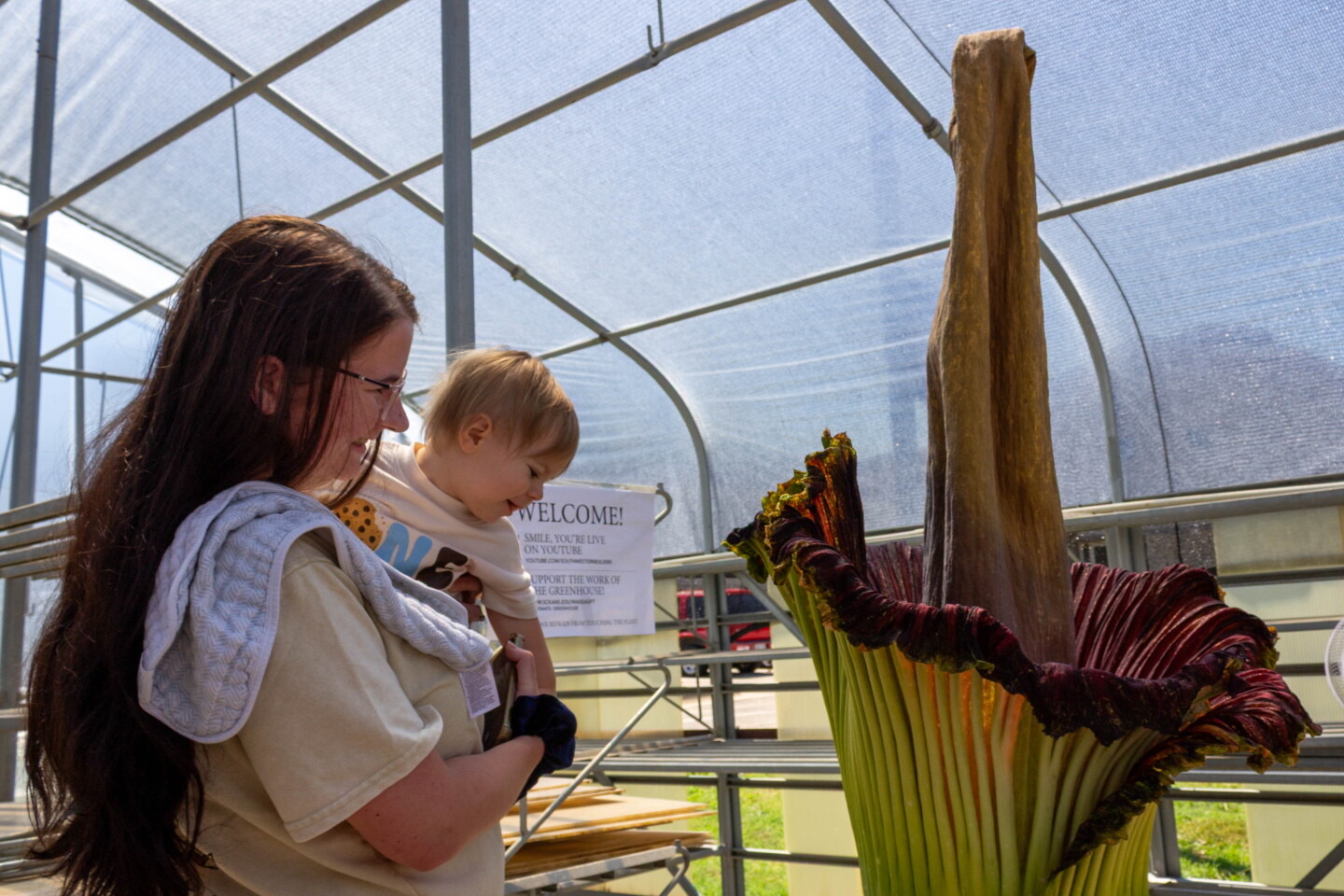
Corpse Flower-2.jpg
Brittany Bowen and her 14-month old son Alastar Bowen take in the sights and smells of Southwestern College's blooming titan arum. The plant has earned the title "the corpse flower" for the distinctive stench it uses to attract pollinators to its bloom. (Meg Britton-Mehlisch / KMUW)

Corpse Flower-6.jpg
"Jinx" a titan arum in Winfield blooms before crowds of onlookers at Southwestern College. The plant, also called a corpse flower, grew to over six feet tall. The deep red coloring of the spathe — the bell-shaped structure of the plant — and a smell of decaying meat are evolutionary tricks the plant uses to attract flies. Flies and carrion beetles come to the flower looking for a dead animal to eat and leave covered in pollen from the plant. (Meg Britton-Mehlisch / KMUW)
1/