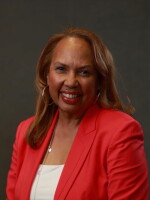
Yusha-Marie Sorzano loves to teach. She keeps a keen eye on the dancers who follow her instructions. She’s a former performer and choreographer with the Alvin Alley Dance Theatre and seven other dance companies. She’s taught internationally, as well as in the United States.
When she got the call from Wichita Ballet, Sorzano was intrigued by the Dockum sit-in and began her research.
“There's a certain amount of reverence that I want to invoke,” Sorzano said. “There's a certain amount of sacred celebration, and I think that's where I'm landing with where the ballet is finding its feet, this is an honoring of something that should be honored.”
The Dockum Drug Store sit-in was one of the first successful lunch counter protests in the United States. It took place in Wichita in 1958, where Black students protested segregation and won the right to be served.
“The fact that these young dancers are starting to understand who Carol Parks Hahn was, who Ron Walters was, who the people were, is really at the heart of it, the most important thing,” Sorzano said. “And I hope at the end of the day, the dancers can walk away feeling growth as performers and as students of the artform. But more than anything, feeling like there's a bit of a moral calling that rights the way of their compass and guides them towards what they were fighting for, inclusivity, treating others as you would want to be treated, dignity and respect.”

Twenty-year-old Shawn Gordon, who’s a sophomore at Wichita State, has been dancing since she was three. She said the dance is meaningful to her as a woman of color.
“I’ve never seen a piece done like this in a celebratory way and so being able to watch and be a part of this as it’s celebrating and giving gratitude, I’m still speechless,” Gordon said. “Every time I drive here and walk in, I’m like, ‘Wow, I cannot believe I’m a part of this and being able to use what I love to express it to other people.’
“I think it’s really special to be able to mix different styles of dance to communicate something.”
Isabelle Johnson, 20, is a University of Kansas student who’s been dancing for 10 years. She and the other dancers appreciate the intricacies of Sorzano’s choreography.
“It's really rigorous, and she really wants you to really dig deep and just do the most and really be expansive and dig into your plie and find that place within yourself. That way you can really commit to the piece,” Johnson said.
Twenty-six-year-old Garth Carey Jr. has danced since he was 16. He’s an intern at Ballet Wichita, a junior at Wichita State and recently started his first year in their dance program. He says he wanted to lift up the voices of those who participated in the Dockum sit-in.
“I needed to use what I can do to amplify the voice of what happened so that more people can be aware of it,” Carey Jr. said.
“It’s not a divisive story. It’s a story about community and coming together to change things, and change things for the positive, and being inclusive and just realizing that the undertones of this is similar to what’s happening now in the world. Back then, they just wanted to sit down and eat. It’s such a mind-blowing thing to think, ‘You just go to a restaurant to sit down to eat, and how they had to work so hard to get very, very basic rights.’”

Dancer Lena Castro, a junior at Wichita State, was reminded of her great-grandmother, who is still alive.
“I recently called her ... she was like, ‘Yes, I remember when things were segregated. Oh, we couldn't sit at the same lunch counter.’ And I was like, ‘That's insane, because I just got into this piece about the Dockum Sit-in,’ and she was like, ‘Yeah, I was alive for that. You have to remember to hold yourself with pride, because there will always be people, and things outside of you, that will try and get you down. But it's important to rely, one on your community, and two, on your own self, pride and preservation, in order to overcome these things.’”
When it comes to music, Sorzano, who is originally from Trinidad and Tobago, has been giving that plenty of thought as well.
“We're talking about breaking barriers, and we're talking about the ballet,” Sorzano said. “Ballet has historically been about stories, right? ‘The Nutcracker,’ ‘Sleeping Beauty,’ ‘Giselle,’ and you're living in that kind of classical world. And I think as we begin to break barriers, and choreographers such as myself that come from, yes, classical ballet training, but also classical modern training and social dance and the sounds of my own island, Soca and Calypso. I think that I'm trying to find ways of balancing that new language, right? That it's not necessarily that I'll speak in complete sentences in classical ballet, and then complete sentences in modern or complete sentences in contemporary, but rather, that they start to use the words of these languages, weave together in a sentence. And so sometimes the music might be touching the classical, but the choreography might be touching the contemporary or it might be touching more of just that basic human instinct to bounce when you hear the blues or any type of music that comes from the drum, the whale, the call, the soul.”
Sorzano will continue to work with the dancers, reaching for the ceiling and showing them explicit moves. Observing how they interpret them down to the final note and designing what she wants the audience to see, to be immersed in the experience.
“The discipline of dance really shapes a powerful human being,” Sorzano said. “It comes down to taking that risk and putting yourself out there. That takes a lot of bravery. And so, I think that to create some sense of tension or some sense of reverence for that bravery is really what I want the audience to take away and to take home the breadcrumbs and the facts that will be enlivening the space before; that they will look around at their Wichita and remember.”